









Ask A Question
If your dog pulls on the lead, a well-fitted front-clip harness is often the better choice. It gives you more control and makes pulling less effective. A back-clip harness is simpler and comfortable for dogs that already walk calmly. Neither harness will stop pulling or teach loose-lead walking on its own, so combine the right dog collars with reward-based training.
Front clip vs back clip at a glance
| Feature | Front clip harness | Back clip harness |
|---|---|---|
| Leash attachment | Center of the chest | Between the shoulder blades |
| Effect on pulling | Redirects the dog sideways or back toward the handler | Lets the dog drive forward against the leash |
| Best for | Dogs that pull, lunge, or need guidance | Calm dogs, puppies learning basic equipment, relaxed walks |
| Main benefit | More directional control | Easy to attach and less likely to tangle |
| Main concern | Poor designs can interfere with shoulder movement | May give a strong puller more leverage |
| Training role | Useful management tool during leash training | Better once leash manners are established |
| Running or hiking | Depends on the individual design | Often more comfortable for steady forward movement |
How a front clip reduces pulling
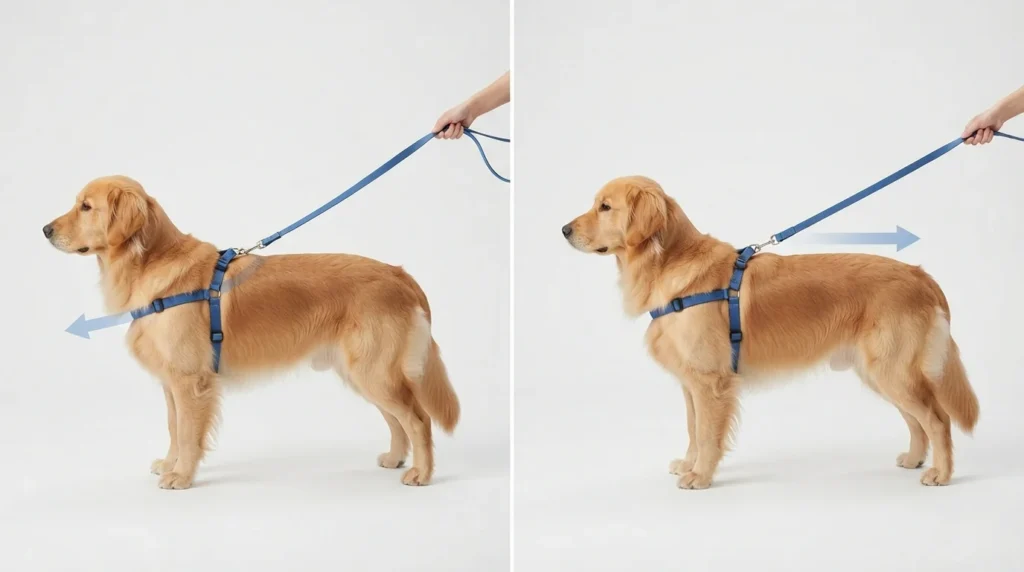
A front clip dog harness for pulling places the leash attachment near the sternum. When the dog surges forward, leash tension does not travel straight down the spine. Instead, it turns the dog’s front end slightly toward you.
That change interrupts forward momentum. The dog has to reorient before continuing, giving you a moment to reward slack in the leash or redirect attention. The American Veterinary Society of Animal Behavior (AVSAB) describes a front clip no-pull harness as an easy management tool that helps dogs walk nicely on leash while you work on training.
This does not mean the harness physically prevents every pull. A determined dog may still lunge, drag, or twist. The harness changes the mechanics in your favor; it does not replace practice.
Front clips can be especially helpful for medium and large dogs whose strength makes a back clip difficult to manage. They may also help when a dog becomes distracted by squirrels, other dogs, or busy sidewalks.
When a back clip makes more sense
A back clip harness attaches above the shoulders. It is usually quick to put on, easy to identify, and less complicated for everyday walks. If your dog already walks on a loose leash, this may be all you need.
Back clip designs can work well for:
- Calm adult dogs with reliable leash manners.
- Small dogs that do not generate much pulling force.
- Casual neighborhood walks.
- Decompression walks where the dog is allowed to sniff and move naturally.
- Hiking or steady forward movement, if the harness does not restrict the shoulders.
The drawback is mechanical. Because the attachment point is aligned with the dog’s body, a dog can often lean into the leash and continue moving forward. This is one reason back clips are not usually the first choice for a strong puller.
Are no pull harnesses safe?
Usually, a no pull harness can be safe when it fits correctly, allows normal shoulder movement, and is used under supervision. “No pull” is a product label, not a guarantee that the dog cannot pull or that every design is equally comfortable.
Check these points before a walk:
| Fit and safety check | What to look for |
|---|---|
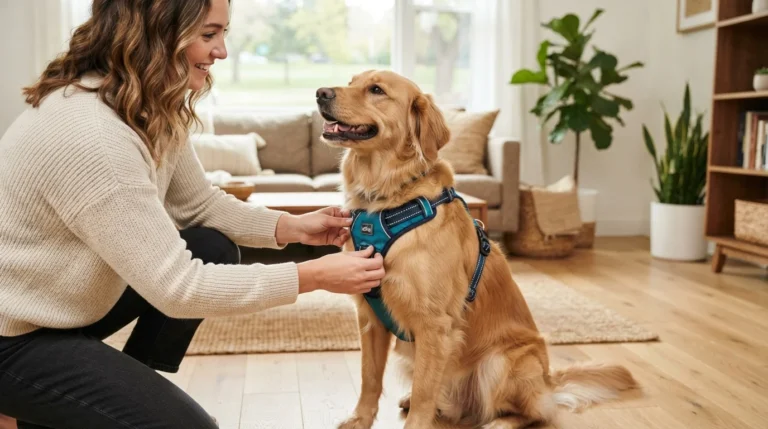
| Strap fit | You should be able to slide about two fingers under the straps, but the fit should still feel snug. |
| Escape check | Gently pull the harness forward toward the head. If it can slip off, tighten the straps. |
| Girth strap position | The girth strap should sit a little behind the front legs, without rubbing the armpits or elbows. |
| Movement | The harness should not rub, pinch, or rotate excessively. |
| Front leg extension | The dog should be able to extend the front legs naturally. |
| Signs of discomfort | The dog should not cough, gag, limp, or show signs of discomfort. |
| Skin condition | Inspect the skin after the first few walks. |
| Supervision | Take the harness off when your dog is home alone or resting in a crate, so the straps cannot snag. |
The American Kennel Club (AKC) recommends checking shoulder extension and making sure the harness does not sit too tightly or interfere with the front legs. VCA Animal Hospitals also warns that some no pull harnesses can press on the front of the shoulder joint. If your dog has orthopedic pain, a recent injury, breathing problems, or an unusual gait, ask your veterinarian or a qualified veterinary rehabilitation professional to assess the fit.
What is a dual clip dog harness?
A dual clip dog harness has both a front attachment and a back attachment. You can use the front ring for training and added steering, then switch to the back ring for calm walks.
Some dual clip harnesses can also be used with a two-ended leash attached to both rings. This can give you more balanced control, but it takes practice to handle two attachment points smoothly. Use only the configuration recommended by the manufacturer, and watch for twisting, rubbing, or restricted movement.
A dual clip is often useful for a transition plan:
- Start with the front clip in a low-distraction area.
- Reward your dog whenever the leash stays loose.
- Move gradually to busier environments.
- Use the back clip once your dog can walk calmly for longer stretches.
- Return to the front clip when distractions become difficult.
What to look for when buying a harness for a dog that pulls
Clip position matters most, but a few design details decide whether a harness stays comfortable and actually helps:
- Attachment points: A front ring for steering, or front and back rings if you want the flexibility of a dual clip setup as training progresses.
- Chest shape: A Y-shaped front that sits on the breastbone and leaves the shoulder joints clear, rather than a strap running straight across the front of the shoulders.
- Adjustment points: Adjustable neck and girth straps, so you can fine-tune the fit as your dog grows, changes weight, or gets groomed.
- Sizing: Measure your dog’s chest girth around the widest part of the rib cage, just behind the front legs, and compare it with the brand’s size chart instead of guessing by breed.
- Hardware: Sturdy rings and secure buckles, since a strong puller puts repeated stress on the front attachment.
- Comfort and visibility: Padding where the straps meet the body, plus reflective trim if you walk early in the morning or after dark.
When you are ready, browse our dog harnesses and check each product’s size chart before you order.
What usually goes wrong
The most common mistake is buying a front clip and expecting instant results. If the dog still receives access to exciting smells, other dogs, or forward movement while pulling, the behavior can continue.
Another problem is choosing a restrictive design. A harness that tightens around the chest or crosses directly over the shoulder may reduce pulling while also changing the dog’s stride. A Y-shaped or similarly well-fitting design may allow more natural movement, but the specific fit matters more than the marketing name.
Avoid jerking the leash to force the dog back. AVSAB recommends reward-based training and advises against aversive tools such as choke, prong, and shock collars because of welfare and behavior risks.
For severe lunging, fear, or aggression, consult a certified force-free trainer or a veterinary behaviorist. A harness can help manage the walk, but it cannot diagnose or treat the reason behind the behavior.
FAQs
Is a front clip or back clip harness better?
A front clip is generally better for a dog that pulls because it redirects the dog’s chest when forward pressure starts. A back clip is usually better for a calm dog that already walks politely. Fit, body shape, and the dog’s walking style matter as much as clip position, so observe movement and check for rubbing.
Do front clip harnesses stop dogs from pulling?
They can reduce the dog’s ability to pull straight ahead, but they do not stop pulling automatically. The chest attachment redirects momentum and gives the handler more control. Reward your dog for a loose leash and pause or change direction when tension appears. The goal is to teach a behavior, not rely on equipment forever.
Are no pull harnesses safe for dogs?
A properly fitted no pull harness is generally safe for many dogs. Problems can occur if the straps pinch, sit in the armpits, tighten excessively, or restrict shoulder movement. Supervise the first walks and check the skin afterward. Stop using the harness if your dog limps, coughs, gags, or shows persistent discomfort.
What is the difference between a front clip and back clip harness?
The leash attaches to the dog’s chest on a front clip and to the upper back on a back clip. A front clip changes the direction of force when the dog pulls, while a back clip generally lets the dog move forward against the leash. Back clips are easier to attach and often suit dogs with good leash manners.
Can a dog still pull with a no pull harness?
Yes. A no pull harness changes leverage, but it does not remove motivation. Dogs may continue pulling toward food, wildlife, people, or other dogs. Use the harness as management while teaching loose leash walking with treats, short sessions, and gradually increasing distractions.
Are dual clip harnesses better?
They can be more versatile, especially when a dog needs front clip control during training and back clip comfort during calm walks. They are not automatically better for every dog. Make sure both attachment points are strong, the harness does not twist, and the two-leash configuration does not restrict movement.
What harness is best for a dog that pulls?
A well-fitted front clip or dual clip harness is a practical starting point for many pulling dogs. Choose one that keeps the leash attachment stable without pressing on the shoulders. For persistent lunging, fear, or aggression, get help from a reward-based trainer or veterinary behaviorist rather than relying on equipment alone.
Next steps for choosing safely
Measure your dog according to the manufacturer’s instructions, then check the harness while your dog is standing, sitting, and walking. Start indoors or in a quiet area and reward calm behavior before testing it near heavier distractions.
If your dog has pain, breathing difficulty, or a changed gait, consult your veterinarian before continuing with the harness.
1 comment
[…] sure whether your dog needs a front clip at all? Our guide to front clip vs back clip harnesses explains which works better for dogs that […]